
informational 5 min read
St Peter's Baldachin: Bernini's Baldacchino and How to See It
Updated October 28, 2026
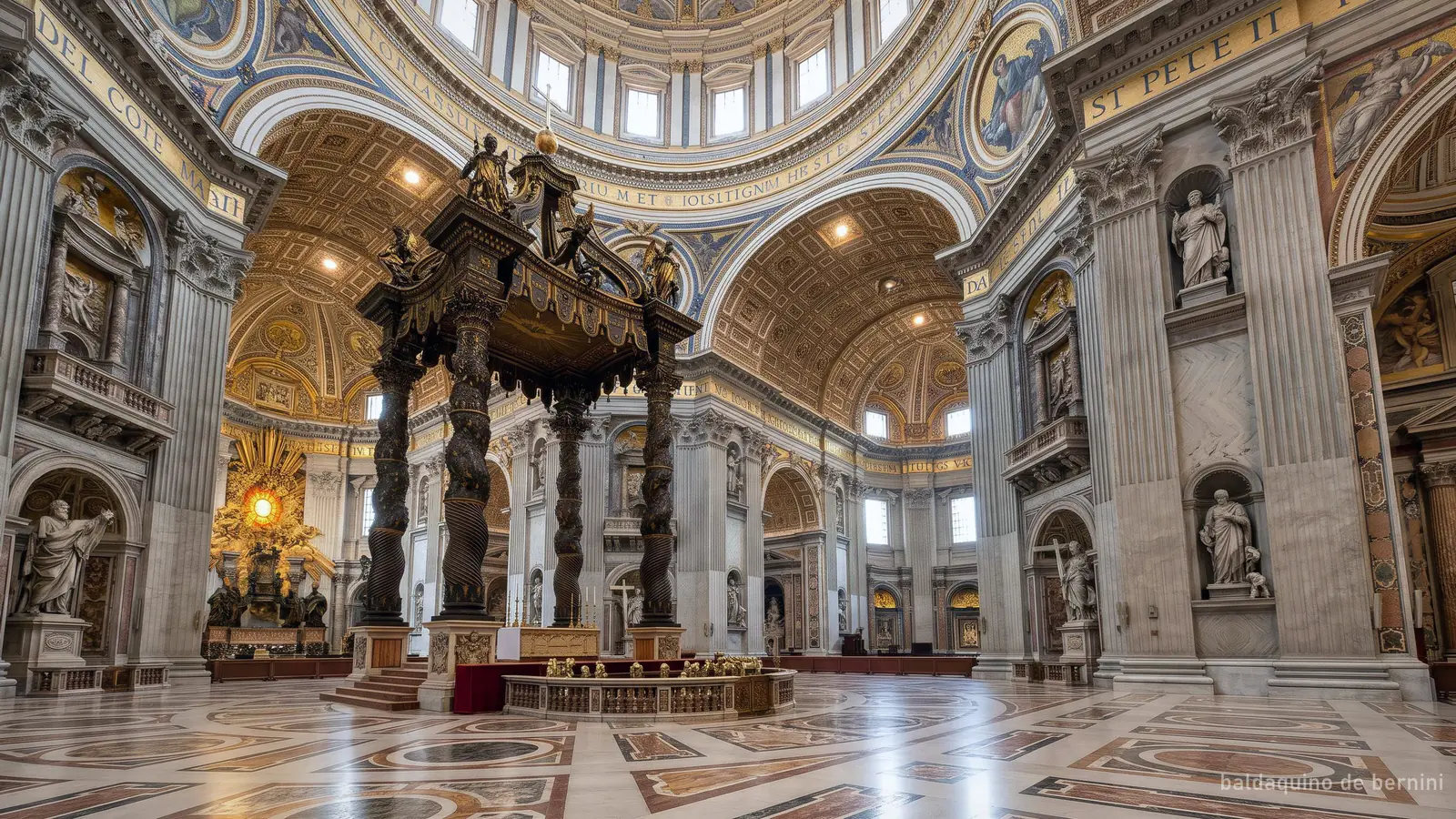
St Peter’s baldachin is a huge bronze canopy by Gian Lorenzo Bernini that covers the papal altar of St Peter’s Basilica, right under the dome and above the tomb of the apostle St Peter. It is 28.5 meters tall, stands on four twisted Solomonic columns and was made between 1623 and 1634 for Pope Urban VIII. You need no ticket to see it: it is inside the basilica, which charges no admission and is open every day from 7:00 to 19:00 until 28 March 2027.
What is St Peter’s baldachin and where is it?
A baldachin, or ciborium, is a canopy on columns that covers an altar. St Peter’s stands at the center of the crossing of St Peter’s Basilica, under Michelangelo’s dome. It covers the high altar, which in turn sits above the crypt with the tomb of St Peter. Tomb, altar, baldachin and dome thus line up on a single vertical axis.
The idea was not new. Temporary baldachins had been used during Lent, and in the 1610s Carlo Maderno had already designed a permanent one with Solomonic columns. The old basilica had twelve Solomonic columns of Greek marble in front of the altar; eight survive in the basilica today, above the statues that face the baldachin, and two in the Chapel of the Blessed Sacrament.
Soon after his election, Urban VIII (pope from 1623 to 1644) gave the commission to Bernini, who was 25 at the time. It was a workshop effort: his father, Pietro Bernini, was the first assistant, and Francesco Borromini worked on it from 1629 to the end, before the two became great rivals.
How tall is Bernini’s baldacchino and what is it made of?
| Fact | St Peter’s baldachin |
|---|---|
| Artist | Gian Lorenzo Bernini and his workshop |
| Commissioned by | Pope Urban VIII |
| Dates | 1623–1634 |
| Total height | 28.5 m |
| Columns | Four Solomonic columns, 20 m each |
| Material | Dark and gilded bronze; white marble bases |
| Style | Baroque |
| Location | Crossing of St Peter’s Basilica, under the dome |
The columns were made in pieces: the white marble bases, the capitals and the shafts, each shaft itself cast in three segments. They have helical shafts, known as Solomonic, with composite capitals, and are covered in laurel leaves, volutes and bunches of grapes.
Above the columns, the canopy imitates fabric, with valances that seem to move in the wind. On the entablature stand angels twice human size and a pair of cherubs holding the papal tiara and the keys of St Peter. It all ends in an orb topped by a cross.
Where did so much bronze come from? According to Wikipedia, the bronzes of the portico of Agrippa’s Pantheon were melted down, although some authors say most of it came from Venice. Hence the saying that caught on in Rome: Quod non fecerunt barbari, fecerunt Barberini, “what the barbarians did not do, the Barberini did”, after the Pope’s family.
What does the baldachin symbolize?
The baldachin marks the most important spot in the basilica: the altar above the tomb of St Peter. Without it, the altar would have been lost in the vastness of the church. It also revives an ancient Christian tradition of raising altars over the tombs of martyrs and under a canopy.
Bernini filled it with symbols, which Wikipedia explains this way:
- The Solomonic columns recall the Temple of Solomon, because in the Middle Ages the old basilica’s columns were believed to have come from it.
- The bunches of grapes symbolize the Eucharist.
- The bees and suns are the emblem of the Barberini family, Pope Urban VIII’s, and they appear everywhere, the bases included.
- The laurel leaves, which replaced vine leaves, may allude to the Pope’s talent as a Latin poet.
- The orb with the cross at the top represents the universality of the Church.
- Under the canopy, above the altar, the Barberini sun surrounds the dove of the Holy Spirit.
Because the baldachin required the high altar to stand at the center of the crossing rather than in the apse, Bernini filled the apse with another of his works: the Chair of St Peter, built between 1656 and 1665.
Wikipedia considers it Bernini’s most outstanding work, and its Solomonic columns, used for the first time since antiquity, inspired countless Baroque works. With Neoclassicism, on the other hand, it came to be seen as a symbol of Baroque excess.
How can you see Bernini’s baldacchino?
Enter St Peter’s Basilica, which charges no admission, and walk up the central nave to the crossing. The baldachin stands under the dome, at the center of the crossing. First you go through the security check in the right-hand colonnade of St Peter’s Square.
Facts for your visit:
- Hours: from 26 October 2026 to 28 March 2027, every day from 7:00 to 19:00.
- Wednesdays: according to operators, the basilica closes on Wednesday mornings for the Pope’s general audience.
- Dress code: shoulders covered and pants or skirts below the knee. No hats.
- No cloakroom: travel light.
On the same route you will find Michelangelo’s Pietà, in the first chapel on the right, and, under the floor, the Vatican Grottoes. To see it from above, climb St Peter’s dome: it costs 22 € with the elevator and 17 € by the stairs, and includes the basilica. Operators highlight the views of the basilica’s interior from the top.
If you would rather have it explained, the St Peter’s Basilica tour with the dome and grottoes is a guided tour from $33, rated 4.8 out of 5 in 6,363 reviews of this tour on GetYourGuide. The other options are in Vatican Museums tickets.
Check prices & dates
Book your tickets in advance: popular time slots sell out.
Book Vatican tickets
From$37per person
Check availability- Free cancellation on 8 of the 9 options
- Reserve now, pay later on 7 of the 9
- Compared with the official 20 € + 5 € ticket
Price checked Oct 27, 2026
Frequently asked questions
How tall is St Peter's baldachin?
28.5 meters, according to Wikipedia. It stands on four 20-meter bronze Solomonic columns.
What is Bernini's most important work?
Wikipedia considers the baldachin Bernini's most outstanding work. Years later he also made the colonnade of St Peter's Square and the Chair of St Peter, in the apse of the basilica.
Did Borromini work on the baldachin?
Yes. Francesco Borromini worked in Bernini's workshop from 1629 until the work was finished, before the great rivalry between the two architects arose.
What does the Barberini saying mean?
"Quod non fecerunt barbari, fecerunt Barberini": what the barbarians did not do, the Barberini did. It caught on because, according to Wikipedia, bronze from the Pantheon's portico was melted down for the baldachin under Pope Urban VIII, a Barberini.
Sources