
Vatican Museums Paintings, Statues and Must-See Highlights
Updated October 28, 2026
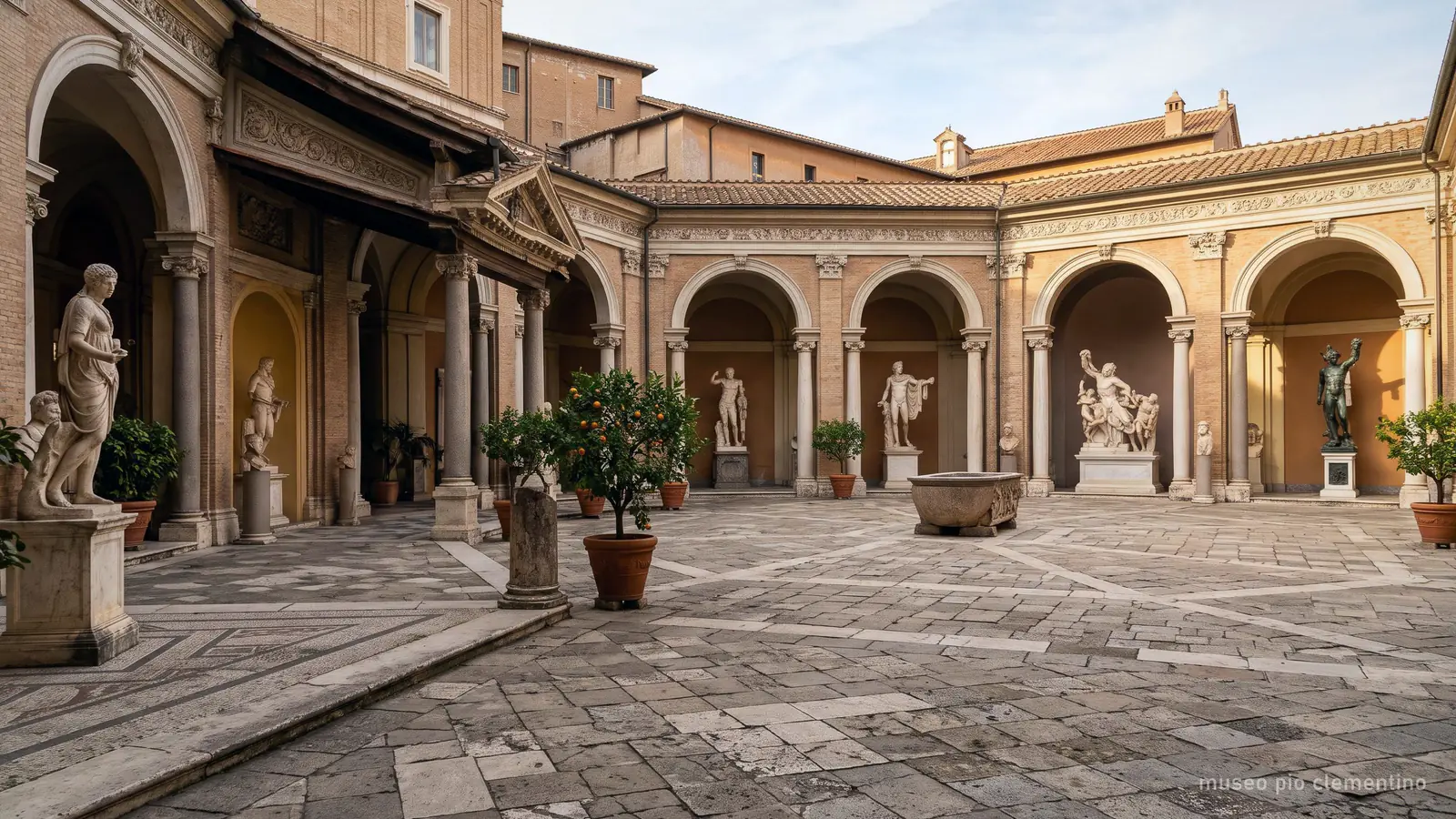
The must-see art in the Vatican Museums is the sculpture of the Pio-Clementino Museum, the Gallery of Maps, the Raphael Rooms and the Sistine Chapel, and you meet them in that order along the route, with the greatest Vatican Museums paintings saved for last. The Pio-Clementino was the first Vatican museum: Pope Clement XIV founded it in 1771 and Pius VI enlarged it. It displays Greek and Roman sculpture in twelve rooms and in the Octagonal Court, where Julius II gathered his collection in the early 16th century. The full route has about 7 km of galleries, so this list helps you prioritize. Remember that you cannot take photos in the Sistine Chapel.
- #1
Laocoön and His Sons
The group Julius II brought to the Belvedere after it was found in 1506.
A 2.42 m white marble group showing the death of the Trojan priest Laocoön and his two sons, attacked by sea serpents. It was dug up in Rome in 1506, and Julius II acquired it for the Belvedere courtyard. It is in the Pio-Clementino Museum. We cover it in Laocoön and His Sons.
- #2
Apollo Belvedere
For centuries, the model of classical beauty.
A marble statue of the god Apollo, considered a Roman copy of a lost Greek original. It has been on display in the Belvedere courtyard since 1511, which gives it its name. It was copied and engraved for centuries as the ideal of the male body. It stands in the Octagonal Court of the Pio-Clementino Museum.
- #3
Belvedere Torso
A fragment signed by an Athenian sculptor.
A 1.59 m fragment of marble sculpture, signed by Apollonius, son of Nestor, of Athens. Today it is thought to be a 1st-century BC copy of an older work. It stands in the center of the Room of the Muses in the Pio-Clementino Museum.
- #4
Augustus of Prima Porta
Rome's first emperor, in marble.
A statue of Augustus discovered on 20 April 1863 in the villa of Livia at Prima Porta, on the outskirts of Rome. It is a marble copy of an earlier bronze model. It is in the Museums' Braccio Nuovo.
- #5
Gallery of Maps
120 meters of Italy painted in 40 maps.
A gallery on the west side of the Belvedere courtyard with 40 panels of topographical maps of Italy, painted from drawings by the friar and geographer Ignazio Danti. Pope Gregory XIII commissioned it in 1580, and it was finished in 1583. It is about 120 m long.
- #6
Raphael Rooms
Four rooms painted by Raphael and his workshop between 1508 and 1524.
Four rooms of the Apostolic Palace decorated in fresco by Raphael and his pupils. In route order they are the Room of Constantine, the Room of Heliodorus, the Room of the Segnatura and the Room of the Fire in the Borgo. After Raphael's death in 1520, his workshop finished the Room of Constantine. More in the Raphael Rooms.
- #7
The School of Athens
Raphael's best-known fresco, with the philosophers of antiquity.
Raphael drew it between 1509 and 1510 and painted it between 1510 and 1511, as part of the commission to decorate the rooms we now call the Raphael Rooms. It is one of his most important works and is part of the night tour of the Vatican Museums.
- #8
Sistine Chapel ceiling and The Creation of Adam
Michelangelo painted it between 1508 and 1512, commissioned by Julius II.
The ceiling has nine scenes from Genesis in its central part: three on the creation of the world, three on the creation of man and his expulsion from Paradise, and three on Noah. The Creation of Adam, painted around 1511, is the fourth of them. Look up and do not take photos: they are banned in the chapel. More in the Sistine Chapel and The Creation of Adam.
- #9
The Last Judgment
The altar wall, painted almost 25 years after the ceiling.
Michelangelo's fresco on the altar wall of the Sistine Chapel. He began it in 1536 and finished it in 1541. Its nudes drew very harsh criticism in its day. We explain it in Michelangelo's Last Judgment.
- #10
The Transfiguration, in the Vatican Pinacoteca
Raphael's last painting, in the Museums' picture gallery.
Raphael worked on it until his death in 1520; it was commissioned by Cardinal Giulio de' Medici, the future Clement VII. It hangs in the Vatican Pinacoteca, opened on 27 October 1932, which brings together about 460 works in eighteen rooms, with works by Giotto, Leonardo and Caravaggio. It occupies a building of its own, built by Luca Beltrami.
- #11
Bramante Staircase and the spiral staircase
Two staircases that people call by the same name.
The Bramante Staircase, from 1507, was designed by Donato Bramante for Julius II and is usually closed to the public. It is often confused with the double-helix staircase at the end of the route, which is a different one: Giuseppe Momo designed it in 1932, inspired by Bramante's. More in the Bramante Staircase.
Frequently asked questions
What should you see in the Vatican Museums?
The sculpture of the Pio-Clementino Museum (Laocoön, the Apollo Belvedere, the Belvedere Torso), the Gallery of Maps, the Raphael Rooms with The School of Athens and the Sistine Chapel, with Michelangelo's ceiling and Last Judgment.
What is the Pio-Clementino Museum?
The first Vatican museum, founded by Clement XIV in 1771 and enlarged by Pius VI. It displays Greek and Roman sculpture in twelve rooms and in the Octagonal Court.
Where is the Gallery of Maps?
On the west side of the Belvedere courtyard, on the route toward the Raphael Rooms and the Sistine Chapel. It is about 120 m long and has 40 maps of Italy.
Can you take photos of the artwork?
Yes, without flash and for personal use throughout the Museums, except in the Sistine Chapel, where photos and video are not allowed. Tripods and selfie sticks are not allowed either.
Sources