
informational 7 min read
Sistine Chapel: Where It Is, Who Painted It and What to See
Updated October 28, 2026
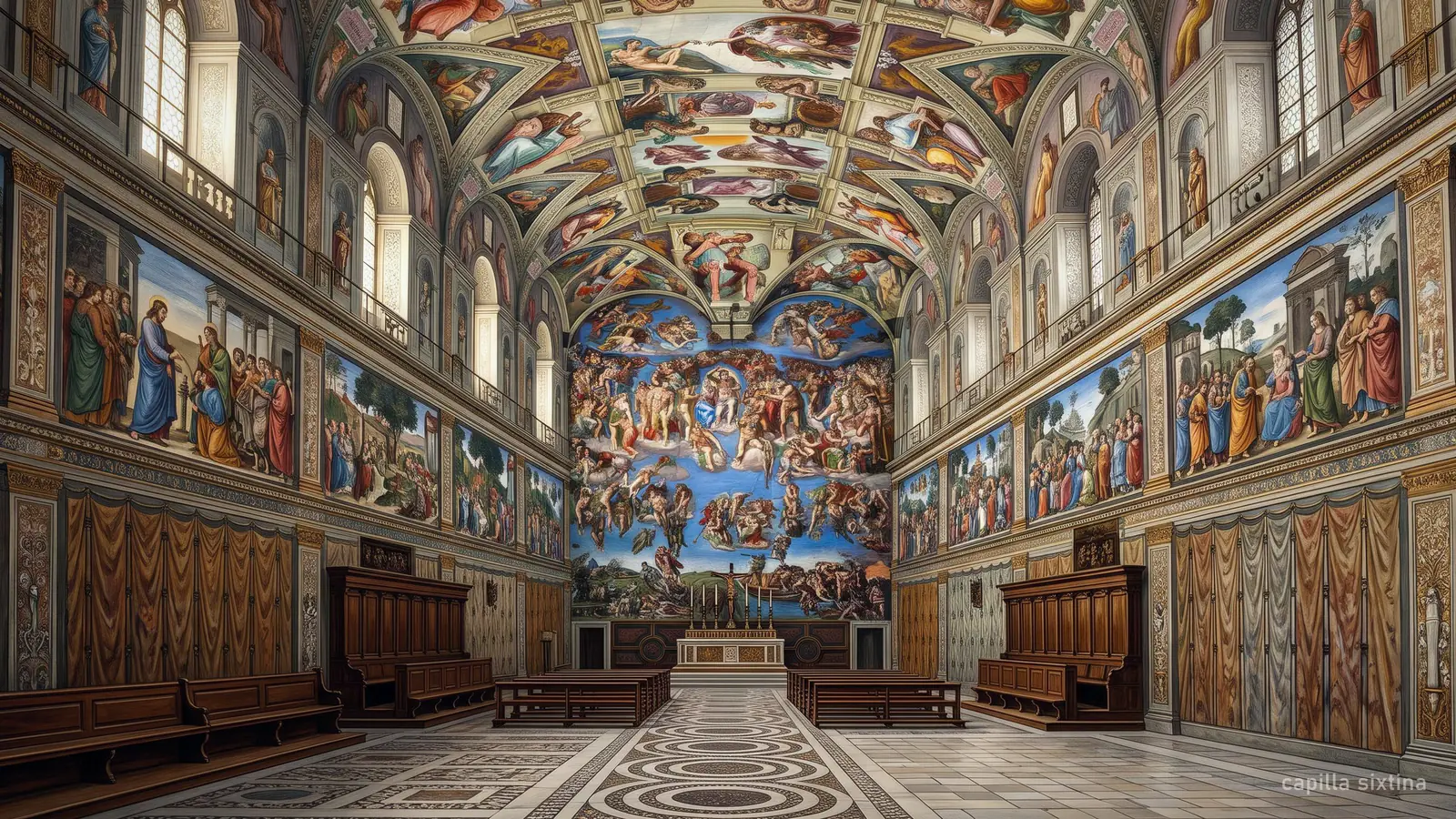
The Sistine Chapel is inside the Apostolic Palace in Vatican City, and you visit it at the end of the Vatican Museums route, on the same ticket. It was painted mainly by Michelangelo: the ceiling between 1508 and 1512 and The Last Judgment, on the altar wall, between 1536 and 1541. The side walls are older, by Botticelli, Perugino, Ghirlandaio and other 15th-century painters. Photos are not allowed inside and you must keep silent.
Where is the Sistine Chapel?
The Sistine Chapel is a chapel of the Apostolic Palace, the Pope’s official residence, and it is part of the Vatican Museums. It has no facade and no entrance from the street: you can only reach it from inside the palace, and from outside it is a tall, plain building you can barely see from the courtyards. That is why you do not enter from St Peter’s Square but through the Museums entrance on Viale Vaticano.
Inside it measures 40.9 meters long by 13.4 wide, the same proportions the Old Testament gives the Temple of Solomon, and the ceiling is 20.7 meters above the floor. The floor is colored marble in geometric patterns, in the Cosmatesque style, and a marble screen divides the room in two.
It takes its name from Sixtus IV, who had the old Cappella Magna rebuilt between 1473 and 1481. The first Mass was held on 15 August 1483, when it was consecrated to the Virgin Mary. It is still in use today: it is the seat of the conclave, the meeting at which the cardinals elect the Pope. Every conclave since 1878 has been held here, and the chimney installed on the roof gives the signal with white or black smoke.
Who painted the Sistine Chapel, and when?
It was painted in two phases: a team of 15th-century painters did the walls, and Michelangelo did the ceiling and the Last Judgment.
| Part | Painter | Dates |
|---|---|---|
| Walls: life of Moses and life of Christ | Perugino, Botticelli, Ghirlandaio, Cosimo Rosselli, Luca Signorelli and assistants | 1481–1482 |
| Ceiling: Genesis, prophets, sibyls | Michelangelo | 10 May 1508 – 31 October 1512 |
| Altar wall: The Last Judgment | Michelangelo | 1536–1541 |
| Entrance wall: two replacement frescoes | Hendrik van den Broeck and Matteo da Lecce (Mateo Pérez de Alesio) | 1572 and 1574 |
The ceiling was commissioned by Pope Julius II. The original commission was to paint the twelve apostles, but Michelangelo asked for freedom over the design and ended up painting more than 300 figures. He saw himself as a sculptor before a painter and, according to Wikipedia, at first would rather have turned the job down. He designed his own wooden scaffold, resting in holes in the walls, after rejecting the one Bramante proposed, hung from the ceiling. Contrary to the usual story, he painted standing up, not lying down.
The Last Judgment was commissioned by Clement VII and confirmed by his successor, Paul III, years after the Sack of Rome in 1527. To paint it, earlier frescoes on the altar wall had to be erased.
In 1515 Raphael also designed ten tapestries for the lower part of the walls, with scenes of St Peter and St Paul. They are hung only for special ceremonies.
What is on the Sistine Chapel ceiling?
The ceiling measures about 40 by 13 meters: Michelangelo painted some 520 m² of fresco. It is organized in three zones:
- The center: nine scenes from Genesis in three groups of three. From the altar, the creation of the world (separation of light from darkness, creation of the sun, moon and plants, separation of land and water); the creation of man and his fall (creation of Adam, creation of Eve, original sin and expulsion from Paradise); and the story of Noah (sacrifice of Noah, the Flood, drunkenness of Noah).
- The sides: twelve figures seated on thrones, seven prophets of Israel and five sibyls of the classical world. Jonah is above the altar.
- The lunettes above the windows: the ancestors of Christ.
When you come in through the main door, the first scene you see is the last one in the story, The Drunkenness of Noah: the order runs backwards. According to Ascanio Condivi, Michelangelo’s first biographer, The Flood was the first scene he painted.
The most famous scene is The Creation of Adam, with the fingers of God and Adam about to touch. It is the fourth of the nine scenes counting from the altar.
What does the Last Judgment depict?
The Last Judgment covers the entire altar wall, 13.7 by 12.2 meters. It depicts the Second Coming of Christ: at the center, Christ judges humanity with the Virgin at his side and the saints around him. Bottom left, the dead rise from their graves and ascend; on the right, the damned are dragged down by demons toward Charon’s boat.
Two details to look for: St Bartholomew holds a flayed skin on which, according to tradition, Michelangelo painted his own face; and in the bottom right corner is Minos, judge of the underworld, with the face of Biagio da Cesena, the papal master of ceremonies who criticized the nudes. Later, Daniele da Volterra covered some of the nudes, which earned him the nickname Il Braghettone. We tell the whole story in the guide to Michelangelo’s Last Judgment.
The frescoes were restored between 1980 and 1994, and the side walls up to 1999. The cleaning removed layers of glue, smoke and wax and brought back vivid colors. Around the Last Judgment a few small areas were left uncleaned so you can see the difference.
Can you take photos in the Sistine Chapel?
No. Photos and video with any device are not allowed in the Sistine Chapel, although in the rest of the Museums you can take photos without flash for personal use. Inside you are asked to keep silent and switch off your phone, because it is still a place of worship. Some guides explain the chapel before going in for that reason.
The dress code applies here too: no sleeveless or low-cut tops, shorts above the knee, miniskirts or caps. More detail in Sistine Chapel photos and in Vatican dress code.
How do you get into the Sistine Chapel?
With the Vatican Museums ticket: there is no ticket for the chapel alone. Official prices are 20 € at the ticket office or 20 € + 5 € online, 10 € reduced, and entry is free for children under 7 and on the last Sunday of each month. The ticket is valid only for the day it is issued for and is non-refundable. Every case is in Vatican Museums ticket prices.
The chapel is at the end of the Museums route, after the Gallery of Tapestries, the Gallery of Maps and the Raphael Rooms. It takes hours to get from the entrance to the chapel, so if you arrive at the last entry, at 18:00, go straight there. The Museums are open Monday to Saturday from 8:00 to 20:00. More detail in the Vatican Museums guide.
If the official website has no slots left, the Vatican Museums and Sistine Chapel ticket we link to costs from $37, rated 4.5 out of 5 in 159,426 reviews of this ticket on GetYourGuide. It is for the date and time slot you choose and is non-refundable. If you want the frescoes explained, the guided tour of the Museums, the Sistine Chapel and the basilica costs from $71. Partner prices are converted from euros at 1 EUR = 1.115 USD (ECB, 27 Oct 2026). Every option is in Vatican Museums tickets.
Torn between the chapel and the basilica? They are not the same thing and you do not have to choose. We compare them in Sistine Chapel or St Peter’s Basilica.
Check prices & dates
Book your tickets in advance: popular time slots sell out.
Book Vatican tickets
From$37per person
Check availability- Free cancellation on 8 of the 9 options
- Reserve now, pay later on 7 of the 9
- Compared with the official 20 € + 5 € ticket
Price checked Oct 27, 2026
Frequently asked questions
Why is it called the Sistine Chapel?
After Pope Sixtus IV, who had the old Cappella Magna rebuilt between 1473 and 1481. The chapel was consecrated to the Virgin Mary on 15 August 1483.
How long did Michelangelo take to paint the Sistine Chapel?
The ceiling took him about four and a half years: he began on 10 May 1508 and finished on 31 October 1512. He painted the Last Judgment later, between 1536 and 1541.
Did Leonardo da Vinci paint the Sistine Chapel?
No. The ceiling and the Last Judgment are by Michelangelo. The side walls were painted by Botticelli, Perugino, Ghirlandaio, Cosimo Rosselli and Luca Signorelli, among others.
Is the Sistine Chapel the same as St Peter's Basilica?
No. The Sistine Chapel is in the Apostolic Palace and is visited with the Vatican Museums ticket. St Peter's Basilica is a different building, with free entry from the square.
How big is the Sistine Chapel?
Inside it measures 40.9 meters long by 13.4 wide, and the ceiling is 20.7 meters high, according to Wikipedia.
Sources