
informational 7 min read
Raphael Rooms: The School of Athens and the Other Rooms
Updated October 28, 2026
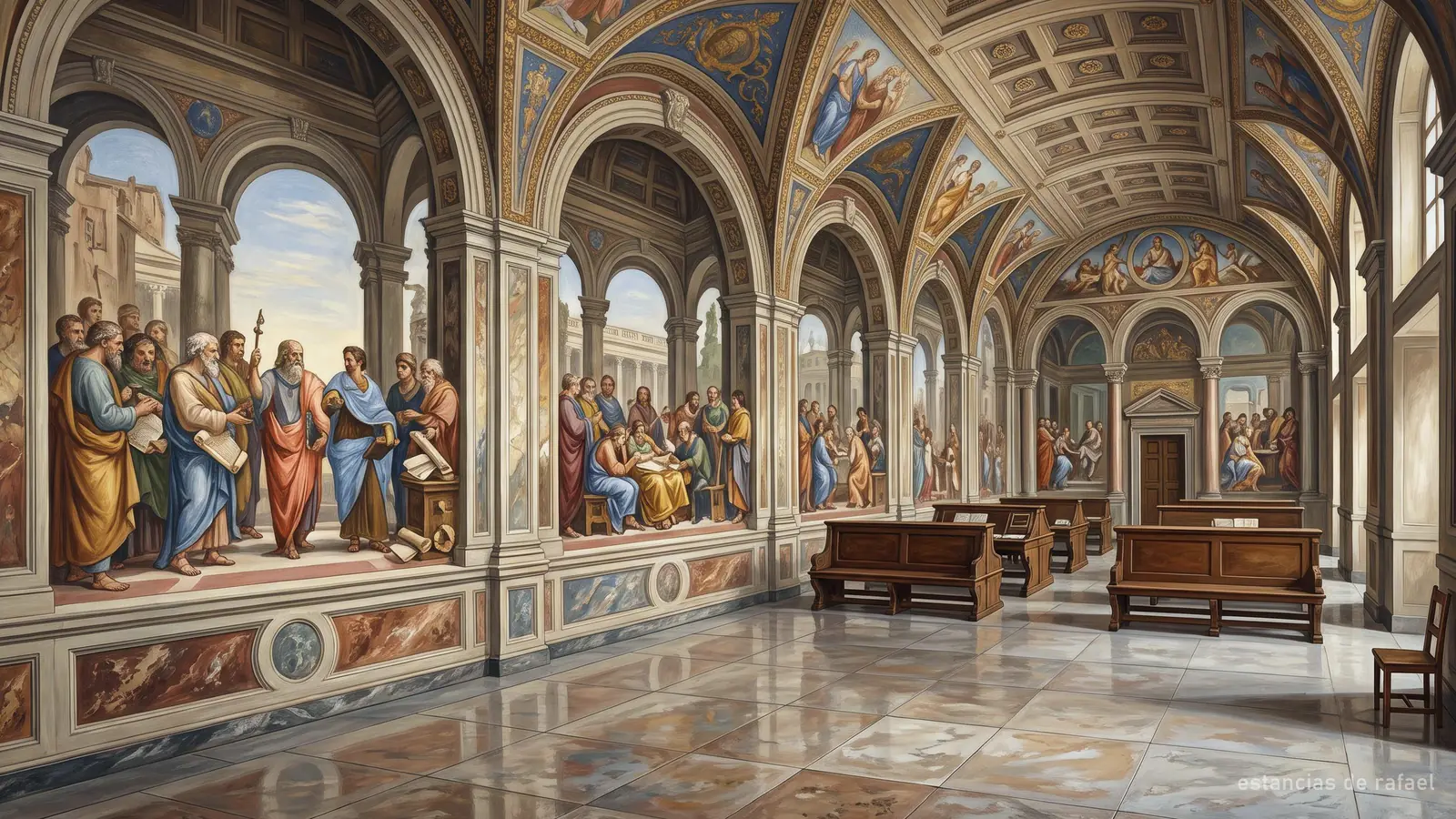
In the Raphael Rooms you see four rooms of the Apostolic Palace frescoed by Raphael and his workshop between 1508 and 1524; the work everyone looks for is The School of Athens, in the Room of the Segnatura. Next to it are the Disputation of the Holy Sacrament and The Parnassus. The other three rooms tell of God’s protection of the Church, the story of two popes named Leo and the life of Constantine. They are covered by the standard Vatican Museums ticket.
The four Raphael Rooms
Julius II wanted to live above the rooms of his predecessor, Alexander VI Borgia. In 1508 he had the frescoes already in those rooms, by Perugino, Sodoma and others, scraped off, and gave the decoration to Raphael, whom Bramante had called from Urbino. After Julius II’s death in 1513, Leo X carried on the program. When Raphael died, in 1520, his assistants finished the last room.
The order in which you walk through them is not the order in which they were painted. From east to west, as a visitor enters, they run: Constantine, Heliodorus, Segnatura and Fire in the Borgo.
| Room | Years | Theme | Best-known fresco |
|---|---|---|---|
| Room of the Segnatura | 1508–1511 | Theology, Philosophy, Poetry and Justice | The School of Athens |
| Room of Heliodorus | 1512–1514 | God’s protection of the Church | The Mass at Bolsena |
| Room of the Fire in the Borgo | 1514–1517 | Popes named Leo (III and IV) | The Fire in the Borgo |
| Hall of Constantine | 1517–1525 | The triumph of Christianity over paganism | Battle of the Milvian Bridge |
Room of the Segnatura: The School of Athens
This is the first room Raphael painted and the one with the most harmonious frescoes of the series. It was Julius II’s study and library, and the Segnatura tribunal met there, where the most important papal documents were signed. Each wall represents a field of thought.
The School of Athens (1509–1510) is 770 cm wide at the base and represents Philosophy. The philosophers of antiquity talk beneath vaulted architecture, like a bath complex, with statues of Apollo and Minerva in the niches. At the center, at the vanishing point, stand Plato and Aristotle: the first points to the sky and the second to the earth.
Who is in The School of Athens?
Besides Plato and Aristotle, Raphael spread philosophers over two levels separated by a flight of steps. Look for three details:
- Michelangelo as Heraclitus. The figure in the foreground, slightly to the left, writing a sonnet, was not in the preparatory cartoon kept in the Biblioteca Ambrosiana in Milan. He has Michelangelo’s face and riding boots. Raphael added him after seeing the first uncovered sections of the Sistine Chapel ceiling.
- Leonardo and Bramante. Raphael also portrayed these two contemporaries of his as philosophers.
- Diogenes. He lies sprawled on the steps, sunning himself.
The Disputation of the Holy Sacrament and The Parnassus
The Disputation of the Holy Sacrament is the first fresco Raphael finished, in 1509. It faces The School of Athens and is also 770 cm at the base. It represents Theology: above, in heaven, the Trinity; below, the Church around the Eucharist. The same idea is repeated on both levels.
The Parnassus (1511) is above one of the windows and measures 670 cm at the base. Apollo plays surrounded by the nine Muses beside the Hippocrene spring. Around him, ancient and modern poets talk, among them Dante, Petrarch, Ariosto and Sannazaro. Over the other window is Jurisprudence, with the cardinal virtues, painted by the workshop.
Room of Heliodorus
This was the Pope’s room for private audiences. Raphael painted it between 1512 and 1514 with help from Penni and Giulio Romano. The theme is God’s protection of the Church, in the years when Julius II led his troops against the foreign powers in Italy, and in every fresco the Pope appears as protagonist or onlooker.
- The Expulsion of Heliodorus from the Temple, which gives the room its name.
- The Mass at Bolsena (1512), which many consider Raphael’s finest work as a fresco painter. Julius II appears kneeling with his Swiss troops, dressed in bright colors: the corps that is today the Swiss Guard had been founded in 1506.
- The Deliverance of St Peter (1514), with three scenes and three lights: that of the moon, that of the angel and that of the real window below it.
- The Meeting of Leo the Great and Attila. Raphael painted Leo I with Julius II’s face and, when Julius died, changed it to Leo X’s.
Room of the Fire in the Borgo
This is the last room Raphael saw finished, although it was mainly carried out by his workshop between 1514 and 1517. Leo X used it as a music room. The frescoes tell episodes of Popes Leo III and Leo IV, painted with the features of Leo X.
The best known is The Fire in the Borgo: a miracle of the year 847 in which Leo IV puts out a fire with the sign of the cross. In the background you can see the facade of the old St Peter’s Basilica, still standing. In the foreground, a man carries another on his shoulders, a quotation of Aeneas fleeing Troy with his father.
Hall of Constantine
This is the largest room and the last to be painted, between 1517 and 1525. The frescoes are by Giulio Romano, Gianfrancesco Penni and Raffaellino del Colle, from Raphael’s designs. Because they are not by his hand they are less famous, but the Battle of Constantine against Maxentius, at the Milvian Bridge (312), is one of the largest military scenes ever painted. The ceiling was decorated by Tommaso Laureti and finished at the end of 1585.
Where are the Raphael Rooms on the route?
They are in the Apostolic Palace, on the upper floors, above the south side of the Belvedere Courtyard. On the itinerary of the night tour we sell, the Rooms come after the Galleries of the Candelabra, the Tapestries and the Maps, and just before the Sistine Chapel. You reach Raphael after three long galleries, so save some energy for these rooms.
Not every guided tour stops in them. Before booking, check that the itinerary names them. Two of the products we sell do: the Vatican Museums night tour, which includes the Rooms and The School of Athens, and the skip-the-line ticket, whose suggested route names the Hall of Constantine and the Room of Heliodorus.
Tips for seeing them well
- Find the Segnatura first. If you are in a hurry, this is the room not to skip.
- Look up. The ceilings have their own program: in the Segnatura, the allegories of Philosophy, Theology, Poetry and Justice that connect with the frescoes on each wall.
- Photos yes, flash no. In the Rooms you can take photos for personal use without flash. In the Sistine Chapel, by contrast, photos and video are not allowed.
- Ticket. The standard ticket costs 20 € at the ticket office or 20 € + 5 € when booked online on the official website. For the rest of the collection’s works, see the Vatican Museums highlights you should not miss.
Check prices & dates
Book your tickets in advance: popular time slots sell out.
Book Vatican tickets
From$37per person
Check availability- Free cancellation on 8 of the 9 options
- Reserve now, pay later on 7 of the 9
- Compared with the official 20 € + 5 € ticket
Price checked Oct 27, 2026
Frequently asked questions
How many Raphael Rooms are there?
Four: the Hall of Constantine, the Room of Heliodorus, the Room of the Segnatura and the Room of the Fire in the Borgo. They are in the Apostolic Palace and were painted between 1508 and 1524.
Which room is The School of Athens in?
In the Room of the Segnatura, the first one Raphael painted. It is on the wall opposite the Disputation of the Holy Sacrament.
Are the Raphael Rooms included in the Vatican Museums ticket?
Yes. They are part of the Vatican Museums route and are covered by the standard ticket, the same one that includes the Sistine Chapel.
Did Raphael paint all the Rooms?
No. Raphael died in 1520. The Hall of Constantine was finished by his assistants Giulio Romano, Gianfrancesco Penni and Raffaellino del Colle following his designs, and in the Room of the Fire in the Borgo it was mainly his workshop that worked.
Can you take photos in the Raphael Rooms?
Yes, for personal use and without flash. The photo ban applies only in the Sistine Chapel.
Sources