
informational 6 min read
Last Judgment Michelangelo: What It Shows and Where to See It
Updated October 28, 2026
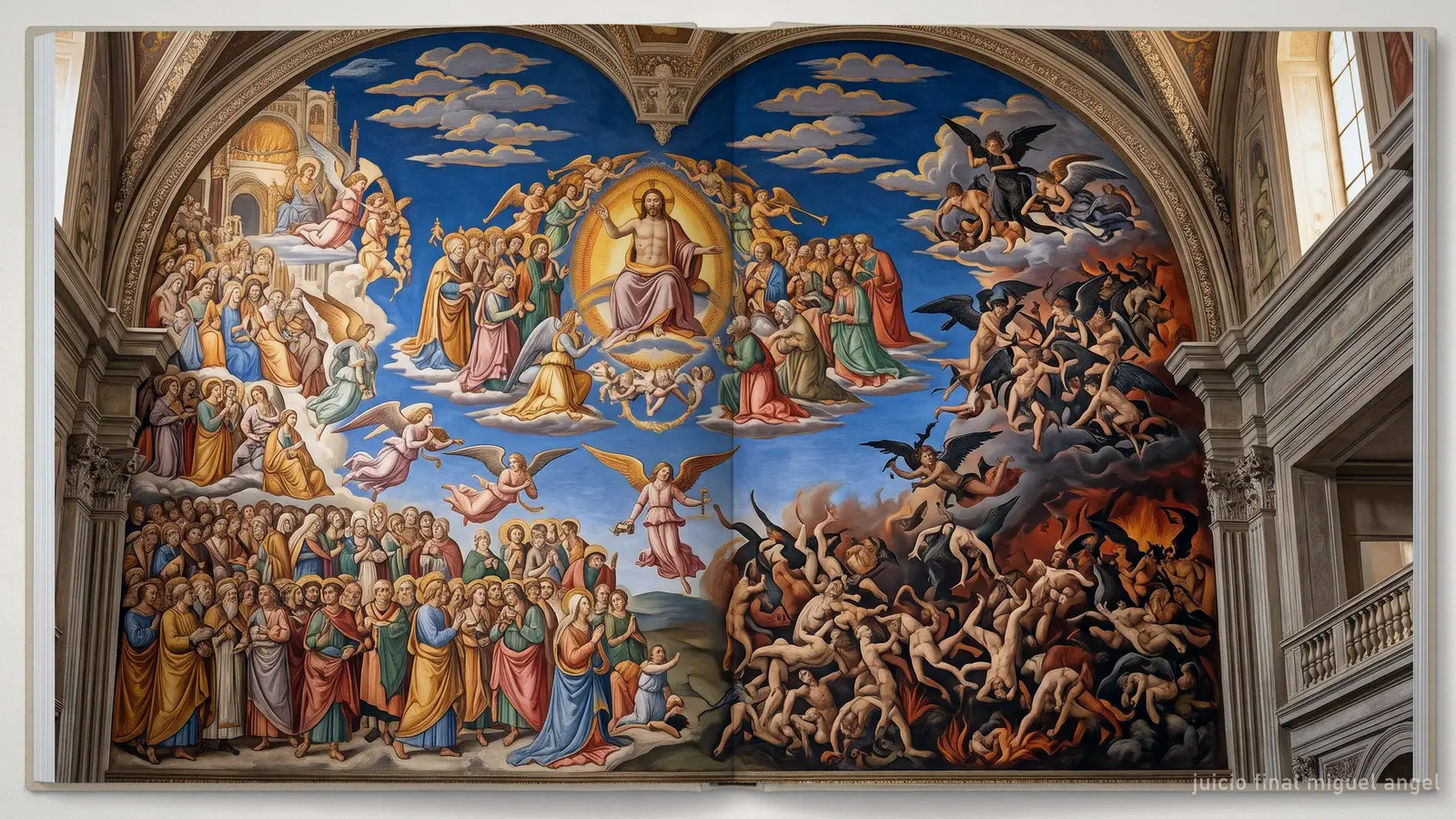
Michelangelo’s Last Judgment in the Sistine Chapel depicts the Second Coming of Christ and the judgment of humanity: at the center, Christ separates those rising to heaven, on the left of the fresco, from the damned descending to hell, on the right. Michelangelo painted it between 1536 and 1541 across the whole altar wall, 13.7 by 12.2 meters. It is the last great fresco you see on the Vatican Museums route, and photos are not allowed inside the chapel.
When and why did Michelangelo paint the Last Judgment?
Michelangelo began the Last Judgment in 1536, almost 25 years after finishing the ceiling of the same chapel, and completed it in 1541. The first commission came from Clement VII, who asked him for a Fall of the Rebel Angels. After that pope’s death, his successor, Paul III, commissioned the Last Judgment for the altar wall in 1535.
The timing explains the subject. Rome had just suffered the Sack of 1527, which ended the Roman Renaissance, and the Protestant Reformation was dividing the Church. The Council of Trent would begin in 1545. According to Wikipedia, the aim was to show humanity facing its salvation.
To paint it, what was already on that wall had to be sacrificed: frescoes by Perugino of the Assumption, the Nativity of Christ and the Finding of Moses, and portraits of the first popes. That loss earned Michelangelo a great deal of criticism.
| Fact | The Last Judgment |
|---|---|
| Artist | Michelangelo |
| Dates | 1536–1541 |
| Commissioned by | Clement VII and, later, Paul III |
| Location | Altar wall of the Sistine Chapel |
| Wall size | 13.7 × 12.2 m |
| Technique | Fresco |
| Restoration | Unveiled on 8 April 1994 |
What does the Sistine Chapel Last Judgment depict?
The subject comes from the Book of Revelation: the end of time, when Christ returns to judge the living and the dead. The fresco reads in bands, from top to bottom:
- At the top, in the two lunettes: angels with the symbols of the Passion. On the left they carry the cross, the crown of thorns and the nails; on the right, the column of the flagellation.
- At the center: Christ, with the marks of the nails and the wound in his side, makes a forceful gesture that separates the righteous from the sinners. Beside him, the Virgin Mary shrinks at his side. Around them, the saints.
- Below Christ: a group of angels blows trumpets. According to Revelation there should be seven, but in the fresco there seem to be eight. Two others hold the book of life and the book of death.
- Bottom left: the dead rise from their graves, some still skeletons, and ascend to heaven helped by angels.
- Bottom right: the damned fall toward darkness. Charon forces them into his boat and demons drag them down.
The style differs from the ceiling’s. The figures are larger and more muscular, crowd together with no landscape or perspective and take strained poses. Wikipedia speaks of Michelangelo’s terribilità, a superhuman force very visible in Christ. The wall also leans slightly toward the viewer at the top, so the scene looms over you from below.
Which details should you look for in the Last Judgment?
Michelangelo painted each saint with the instrument of his or her martyrdom, so they could be recognized. These are the most sought-after:
- St Peter, with the keys of the Kingdom.
- St Bartholomew, who died by being flayed, holding a skin. According to tradition, the face on that skin is Michelangelo’s.
- St Andrew, with his X-shaped cross.
- St Catherine, with the spiked wheel.
- St Lawrence, with the gridiron, and St Sebastian, with the arrows.
- Minos, in the bottom right corner, at the entrance to hell: naked, with donkey ears and a serpent coiled around him. He has the face of Biagio da Cesena, the Pope’s master of ceremonies, who said those nudes belonged in a public bath or a tavern, not a chapel. The story goes that when Biagio complained, Paul III replied that his jurisdiction did not extend to hell.
The story of the nudes continued after the painter’s death. On the orders of Pius V, Daniele da Volterra, a pupil of Michelangelo, covered the genitals of some figures with drapery, which earned him the nickname Il Braghettone, the “breeches painter”. He died two years later without finishing the job.
The colors you see today are those of the restoration. Between 1710 and 1714 the fresco was given a coat of glue meant to protect it, which ended up trapping dust and smoke and darkening it. The 20th-century cleaning brought back vivid colors; some critics think they came out brighter than the originals.
How do you see the Last Judgment on your visit?
You see it with the Vatican Museums ticket, at the end of the route, in the Sistine Chapel. There is no ticket for the chapel alone. Official prices are 20 € at the ticket office or 20 € + 5 € online, and 10 € reduced. The Museums are open Monday to Saturday from 8:00 to 20:00, last entry at 18:00, and are free on the last Sunday of each month from 9:00 to 14:00. The details are in Vatican Museums ticket prices.
When you enter the chapel, the Last Judgment is the far wall, the altar wall. Take in the whole first and then look for the details on the list; on the ceiling above you is the vault with The Creation of Adam.
Keep the chapel’s rules in mind:
- No photos or video with any device.
- Silence is requested and phones must be switched off.
- Dress code: no sleeveless or low-cut tops, shorts above the knee, miniskirts or caps.
Since you cannot talk inside, guided tours explain the fresco before going in. The guided tour of the Museums, the Sistine Chapel and the basilica costs from $71, rated 4.7 out of 5 in 19,233 reviews of this tour on GetYourGuide. If you would rather go on your own, the Vatican Museums and Sistine Chapel ticket costs from $37 and is non-refundable. Partner prices are converted from euros at 1 EUR = 1.115 USD (ECB, 27 Oct 2026). Every option is in Vatican Museums tickets.
Check prices & dates
Book your tickets in advance: popular time slots sell out.
Book Vatican tickets
From$37per person
Check availability- Free cancellation on 8 of the 9 options
- Reserve now, pay later on 7 of the 9
- Compared with the official 20 € + 5 € ticket
Price checked Oct 27, 2026
Frequently asked questions
Where is Michelangelo's Last Judgment?
On the altar wall of the Sistine Chapel, in the Apostolic Palace in Vatican City. You see it at the end of the Vatican Museums route, on the Museums ticket.
How long did Michelangelo take to paint the Last Judgment?
About five years: he began it in 1536 and finished it in 1541, almost 25 years after completing the ceiling of the same chapel.
How big is the Last Judgment?
The wall it covers measures 13.7 by 12.2 meters, according to Wikipedia. The fresco covers the entire wall behind the altar.
Where is Michelangelo's self-portrait in the Last Judgment?
According to tradition, on the flayed skin held by St Bartholomew, one of the saints around Christ. The saint died by being flayed, which is why he holds his own skin in his hand.
Sources