
informational 7 min read
Vatican History: From the Vatican Hill to Today
Updated October 28, 2026
Vatican history begins on a hill outside ancient Rome, home to a circus and a cemetery, continues with the basilica Constantine raised over the tomb of St Peter and ends in 1929, when the Lateran Pacts created the State of Vatican City. In between, the popes ruled the Papal States for more than a thousand years, and in 1506 Julius II began gathering the collection that is today the Vatican Museums. Here is the history of the Vatican in order.
Why is it called the Vatican?
After the Vatican Hill, the Mons Vaticanus. The origin of the name is unclear. It may come from the Latin vaticinium, prediction or prophecy, because there was an Etruscan oracle on the hill, or from the name of an Etruscan settlement called Vaticum. Today the state occupies a rise in those hills, near the right bank of the Tiber.
Caligula’s circus and Peter’s tomb
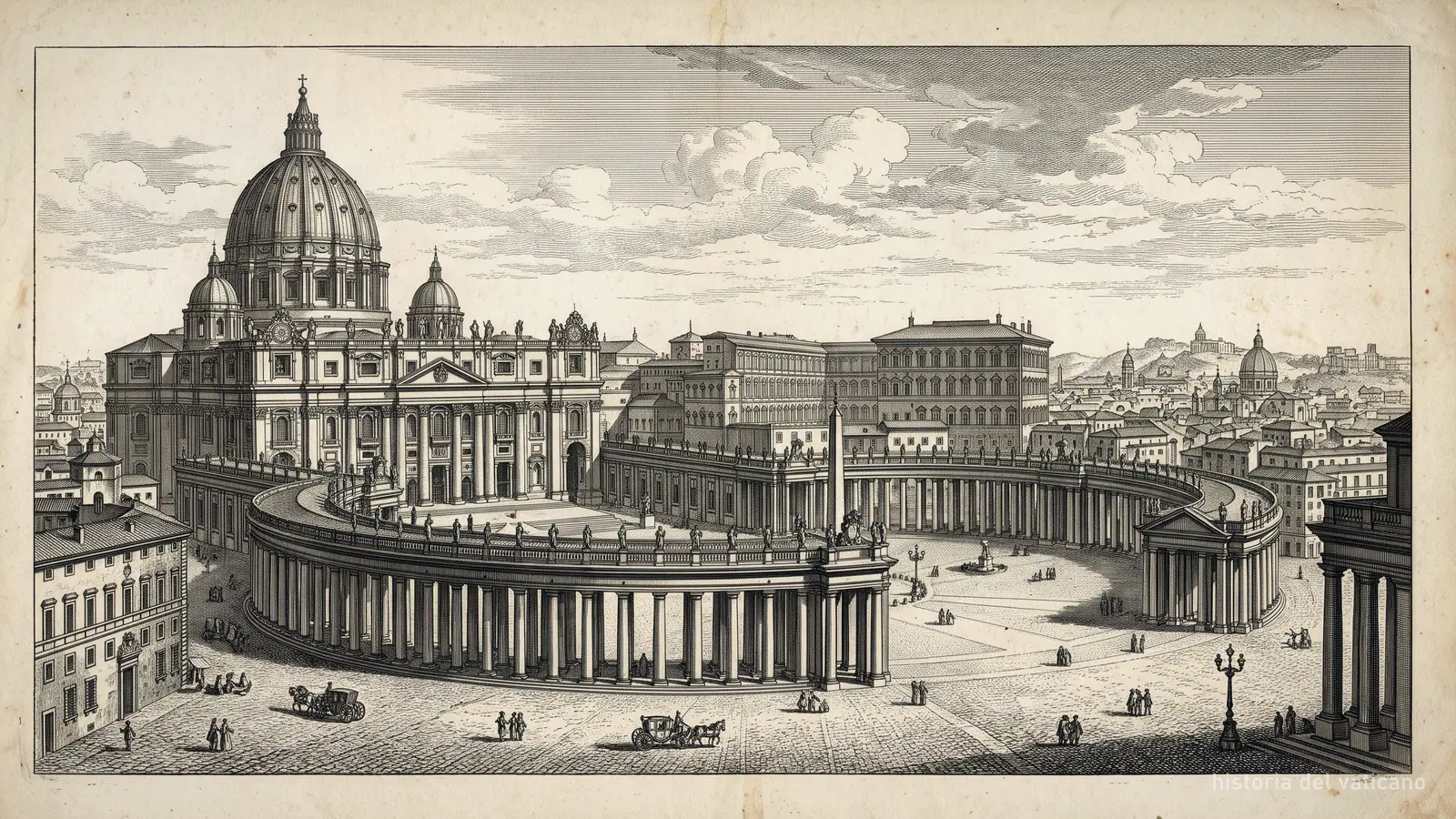
In antiquity the hill lay outside the city, and villas were built there. Emperor Caligula (AD 37–41) had a private circus built, which Nero finished. At its center he set up an Egyptian obelisk. That obelisk still stands: in 1586 Domenico Fontana moved it, on the orders of Sixtus V, to the center of today’s St Peter’s Square.
Many Christians were martyred in the circus and the neighboring gardens in Nero’s time. According to tradition, St Peter was crucified there around the year 64 or 67 and buried in the nearby necropolis. Roman law banned burials inside the city, so the cemetery grew along the road, the Via Cornelia. That cemetery is today the Vatican Necropolis.
From Constantine’s basilica to Michelangelo’s
After legalizing Christianity, Emperor Constantine raised a great basilica over Peter’s tomb between 324 and 326. To get level ground, he had part of the necropolis filled in.
A thousand years later, the old basilica was close to collapse. Nicholas V commissioned Bernardo Rossellino to rebuild it in 1452, but work stopped after three years. Julius II restarted it in 1506 with Bramante’s design. Raphael followed, then Michelangelo, who designed the dome, and finally Bernini. The basilica was completed under Paul V in 1626; his name is on the facade.
The popes’ residence
For centuries the popes lived at the Lateran. In 1279 Nicholas III moved the residence to the Vatican and enclosed it with walls, with an orchard, a meadow and a garden. That is the origin of the Vatican Gardens.
Meanwhile, the popes were also kings. The Papal States were a group of territories in central Italy ruled by the popes, with Rome as capital, from the mid-8th century (756, under Stephen II) until 1870. For protection, Julius II created the Swiss Guard in 1506, which in 1527 defended Clement VII during the Sack of Rome.
1870: the “Roman Question”
In 1860 the army of Victor Emmanuel II conquered almost all of the Papal States. In 1870, taking advantage of the Franco-Prussian War, it took Rome and proclaimed it capital of the Kingdom of Italy, from 1 January 1871. Pius IX and his successors did not recognize that conquest and declared themselves “prisoners” in the Vatican. For almost sixty years, the Pope did not leave it. The conflict between Italy and the Church was called the “Roman Question”.
When did the Vatican become a country?
On 11 February 1929, with the Lateran Pacts. They were signed by Cardinal Pietro Gasparri, Secretary of State, on behalf of Pius XI, and by Benito Mussolini, on behalf of King Victor Emmanuel III. There were three agreements:
| Agreement | What it did |
|---|---|
| Treaty | Recognized the independence and sovereignty of the Holy See and created the State of Vatican City |
| Concordat | Regulated civil and religious relations between the Italian government and the Church in Italy |
| Financial convention | Compensated the Holy See for its losses of 1870 |
The new state was born with 44 hectares. That same year the Vatican postal service, Poste Vaticane, began operating, on 1 August. The palace of Castel Gandolfo received extraterritorial status and became the popes’ summer residence again. The pacts were revised in 1984, mainly so that Catholicism would no longer be the state religion of Italy.
The Vatican Museums since 1506
The Museums grew out of the private collection of Julius II. On becoming pope, in 1503, he placed ancient statues in the Belvedere Courtyard: the Apollo Belvedere, the Venus Felix and, after its discovery on 14 January 1506, Laocoön and His Sons. That is why 1506 is taken as the birth date of the Museums. Earlier, Sixtus IV had built the chapel that bears his name, the Sistine, in 1471.
| Year | What opened or was created |
|---|---|
| 1506 | Julius II’s sculpture collection in the Belvedere |
| 1508–1524 | Raphael Rooms |
| 1769–1799 | Pio-Clementino Museum (Clement XIV and Pius VI) |
| 1800 | Chiaramonti Museum, arranged by Antonio Canova |
| 1837 | Gregorian Etruscan Museum |
| 1839 | Gregorian Egyptian Museum |
| 1932 | Vatican Pinacoteca, opened by Pius XI |
Some works traveled far. After the Treaty of Tolentino, in 1797, Napoleon took pieces such as the Laocoön to Paris; they returned to Rome after the Congress of Vienna in 1815.
From the 1929 state to today
- 1939. The Vatican declares itself neutral in World War II.
- 1940–1949. Excavations under the basilica in search of Peter’s tomb.
- 1962–1965. Second Vatican Council.
- 1984. UNESCO declares the whole site a World Heritage Site, the only listing that covers an entire state.
- 2001. John Paul II’s Fundamental Law of the state comes into force.
- 2023. A new Fundamental Law, by Francis, in force since 7 June.
- 2025. Francis dies and the conclave of 8 May elects Leo XIV.
If you want the country’s facts as it is today, population, area and government, carry on with our guide to Vatican City.
Check prices & dates
Book your tickets in advance: popular time slots sell out.
Book Vatican tickets
From$37per person
Check availability- Free cancellation on 8 of the 9 options
- Reserve now, pay later on 7 of the 9
- Compared with the official 20 € + 5 € ticket
Price checked Oct 27, 2026
Frequently asked questions
What is the history of the Vatican in a nutshell?
On the Vatican Hill there was a Roman circus and a burial ground where, according to tradition, St Peter was buried. Constantine built a basilica there, the popes settled next to it, ruled the Papal States until 1870, and in 1929 the Lateran Pacts created the State of Vatican City.
When was the Vatican founded?
As a state, on 11 February 1929, with the signing of the Lateran Pacts between the Holy See and the Kingdom of Italy. As a place of worship, its history begins with the basilica Constantine built between 324 and 326.
When was today's St Peter's Basilica built?
Work resumed under Julius II in 1506, with Bramante's design, and ended under Paul V in 1626. Michelangelo designed the dome and Bernini was the last great architect to work on it.
How old are the Vatican Museums?
They grew out of the collection of Julius II, who placed ancient sculptures in the Belvedere Courtyard from 1506, the year the Laocoön was discovered.
Sources