
informational 7 min read
Tomb of St. Peter: How to Visit the Vatican Necropolis
Updated October 28, 2026
To visit the tomb of St. Peter in the Vatican Necropolis, you have to request the visit on the official St. Peter’s Basilica website, on its “The Necropolis” page. The Scavi tour is a guided visit in groups of ten to fifteen people, lasting about an hour and a half, that goes 5 to 12 meters below the basilica and ends beside the apostle’s tomb. It is not included in any Vatican Museums ticket or in the tours we sell. If you cannot get a place, the Vatican Grottoes, one level up, can be seen without that booking.
What is the Vatican Necropolis?
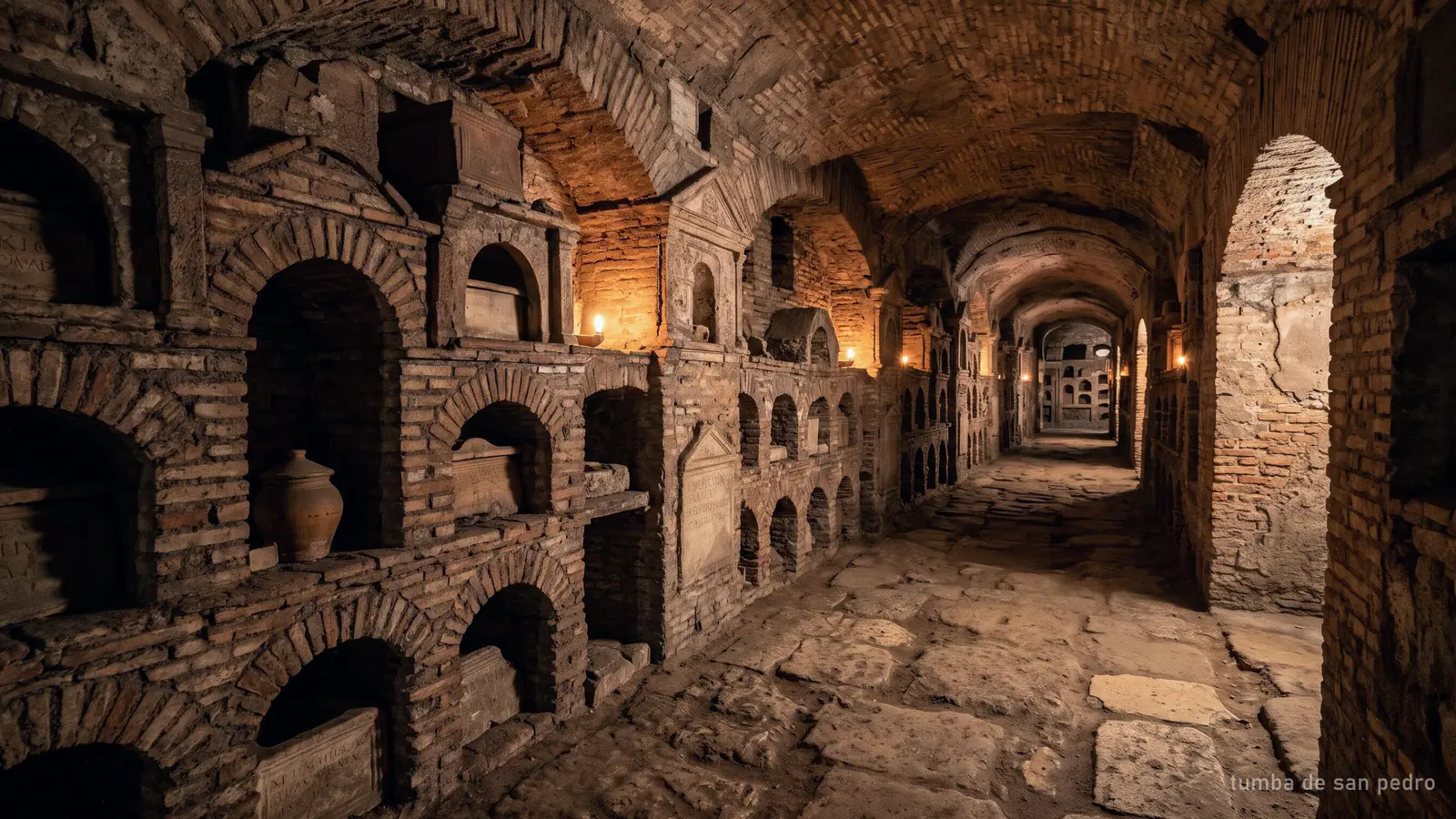
It is an open-air Roman cemetery, with streets of mausoleums, that ended up buried beneath the basilica. It lay on the southern slope of the Vatican Hill, next to the circus begun by Caligula and finished by Nero. Roman law banned burials inside the city, so cemeteries grew up along the roads, in this case the Via Cornelia.
Between 324 and 326 the emperor Constantine had the slope leveled to build the first basilica. He filled the mausoleums with earth and rubble and left only Peter’s tomb visible. The necropolis stayed that way for sixteen centuries, until the excavations Pius XII ordered between 1940 and 1949. Pius XI had asked to be buried as close as possible to St. Peter, and that request set off the search.
The 22 excavated tombs are estimated to hold more than a thousand burials. In mausoleum H alone, at least 170 have been counted. The best known is the tomb of the Julii, or mausoleum M, with a 3rd- or 4th-century mosaic on the vault showing the Sun in his chariot, surrounded by vine leaves.
What does necropolis mean?
Necropolis comes from the Greek nekrós, dead, and pólis, city: “city of the dead”. The basilica itself explains this on its website when presenting the visit, and adds that the place actually offers a glimpse of the daily life and beliefs of the people who used it. It is not to be confused with catacombs: the Vatican Necropolis was an open-air cemetery, not galleries dug underground.
The tomb of St. Peter: what was found
According to tradition, Peter was martyred in the Circus of Nero around the year 64 or 67 and buried in the necropolis next door. About a hundred years later a small monument was built over his tomb, against the so-called “red wall”. Gaius, a theologian who lived in Rome in the early 3rd century, called it the “trophy”, which is why it is known as the Trophy of Gaius.
At right angles to that monument stands the graffiti wall, covered in Latin inscriptions. Human bones turned up in a marble-lined cavity in that wall. The archaeologist Margherita Guarducci argued that they were Peter’s remains, moved there when Constantine’s basilica was built.
The Church has said two things at two different times:
| Year | Who | What was said |
|---|---|---|
| 1950 | Pius XII | It could not be confirmed with absolute certainty that the remains were the apostle’s |
| 1968 | Paul VI | The relics had been identified “in a convincing way” |
Can you visit the tomb of St. Peter?
Yes, but only on the necropolis visit. Here is how to request it:
- Go to the basilica’s official website (basilicasanpietro.va), section “The Necropolis”, and click “Request a booking”. It is handled by the Excavations Office of the Fabbrica di San Pietro.
- Give the date and the language you want. The visit is done in a group with a guide, in the language booked.
- Request well in advance. For conservation reasons only small groups of ten to fifteen people are admitted, so places are few.
- Check the conditions the form shows you. The official page does not publish the price or the minimum age openly; they appear when you request the booking.
If you have questions, the website itself has a Visitor Services desk.
What the visit is like
- Length. About an hour and a half.
- Ending. It ends at the tomb of St. Peter, and from there you go back up into the basilica.
- Clothing. The basilica’s dress code applies: long trousers or below the knee, skirts below the knee and covered shoulders. We sum it up in the Vatican dress code.
- Bags. The basilica has no cloakroom, so bring only a small backpack.
- Access. You go in through the Italian police security checks under the right-hand colonnade of St. Peter’s Square.
How it differs from the grottoes
Three underground spaces are often confused. Two lie beneath St. Peter’s Basilica; the third is next to the Museums.
| Vatican Necropolis (Scavi) | Vatican Grottoes | Via Triumphalis Necropolis | |
|---|---|---|---|
| What it is | Roman cemetery with Peter’s tomb | Level of the old basilica with the tombs of popes | Roman cemetery beside a road |
| Depth | 5–12 m below the basilica | About 3 m below the nave | On the terraces of the Vatican Hill |
| Run by | Fabbrica di San Pietro | Fabbrica di San Pietro | Vatican Museums |
| How to see it | Booking only, guided visit | No necropolis booking needed; the basilica opens them to visitors | Its own ticket on the Museums’ official shop |
| More information | This page | Vatican Grottoes | Vatican Museums website |
The Grottoes correspond to the lower floor of Constantine’s old basilica, about 3 meters below the current one. Among others, Pius XII, Paul VI, John Paul I and Benedict XVI are buried there. They lie above the necropolis, but the Roman mausoleums can only be visited with a Scavi booking.
The Via Triumphalis is another necropolis, separate from Peter’s. The Museums present it as an exceptional example of a Roman cemetery, with the tombs of middle-class and humble people of imperial Rome, many with their headstone and name. It is booked on the Museums’ website, not the basilica’s.
If you cannot get a place
Necropolis places sell out fast because of the group size. The nearest alternative is to go down to the Grottoes. If you want to do it with a guide, the St. Peter’s Basilica tour with the dome and grottoes includes a guided walk through the papal tombs, from $33, rated 4.8 out of 5 in 6,363 reviews of this tour on GetYourGuide. It is not the necropolis: you do not reach the original tomb, only the level of the Grottoes.
To understand how this cemetery became the center of a state, read the history of the Vatican.
Check prices & dates
Book your tickets in advance: popular time slots sell out.
Book Vatican tickets
From$37per person
Check availability- Free cancellation on 8 of the 9 options
- Reserve now, pay later on 7 of the 9
- Compared with the official 20 € + 5 € ticket
Price checked Oct 27, 2026
Frequently asked questions
Can you visit the tomb of St. Peter?
Yes, on the Vatican Necropolis tour, which you request on the official St. Peter's Basilica website. It is a guided visit in small groups that ends beside the apostle's tomb. Without that booking you can see the Vatican Grottoes, one level up.
What are the Vatican Scavi?
Scavi means "excavations" in Italian. It is the name the Vatican Necropolis goes by, because the visit is run by the Excavations Office of the Fabbrica di San Pietro.
How long is the Scavi tour?
About an hour and a half. It ends at the tomb of St. Peter, and from there you go back up into the basilica.
Is the necropolis the same as the Vatican Grottoes?
No. The necropolis is a Roman cemetery from the 1st to the 4th century, 5 to 12 meters below the basilica, and can only be visited with a booking. The Grottoes lie about 3 meters below the nave, hold the tombs of popes and are part of a visit to the basilica.
Are St. Peter's bones in the necropolis?
In 1968 Paul VI announced that the apostle's relics had been identified in a convincing way, based on bones found in a niche in the so-called graffiti wall. In 1950 Pius XII had said this could not be confirmed with absolute certainty.
Sources